
A 2026 Reflection on Mindset, Risk, and Consistency
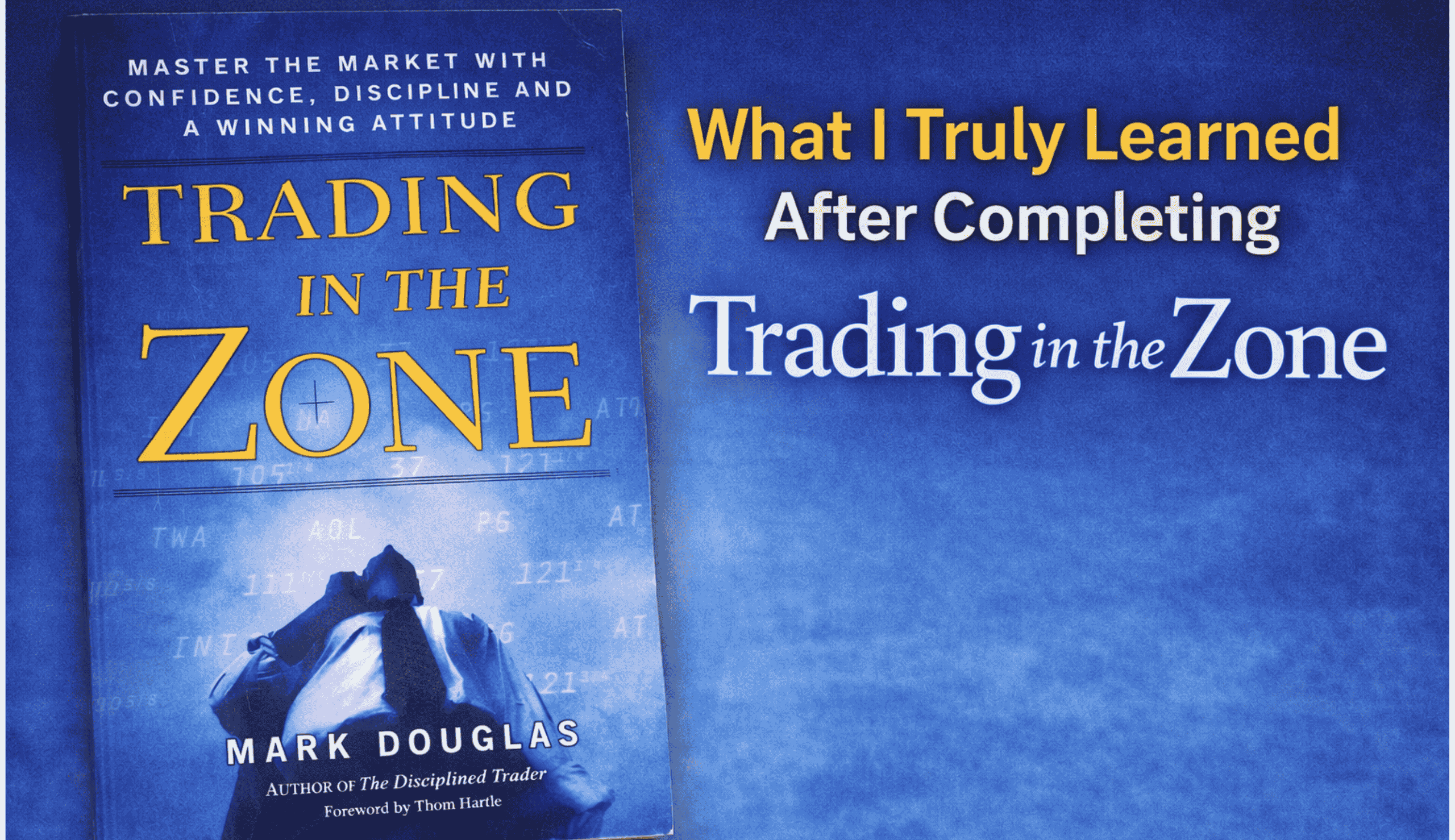
When I finished Trading in the Zone, I didn’t feel excited or confident.
I felt exposed.
Not because the book showed me a new strategy,
but because it revealed how much of my trading struggle had nothing to do with the market.
This book is not about setups, indicators, or predictions.
It is about how a trader thinks.
And that changed everything for me.
1. Risk Management Starts With Responsibility
Before this book, I thought risk management meant stop-loss placement and position sizing.
Now I understand it begins much deeper.
Risk management is taking responsibility.
Responsibility for:
- Being wrong
- Losing money
- Acting without certainty
Losses are not mistakes.
They are simply the cost of doing business.
Once I truly accepted risk before entering a trade, fear stopped controlling my decisions.
I no longer needed the market to prove me right.
2. Consistency Is a State of Mind, Not a Strategy
One of the hardest truths in the book is this:
Consistency does not come from strategy.
It comes from beliefs.
Most traders keep searching for better systems because it’s easier than changing how they think.
But without the right mindset, even the best setup breaks under pressure.
Consistency is not what you trade.
It’s how you think while trading.
3. The Dynamics of Perception & Mental Software
The market does not cause emotional pain.
Perception does.
Fear, ego, and past experiences distort how we see market information.
That’s why Mark Douglas talks about debugging your mental software.
Perception affects:
- How we learn
- How we manage risk
- How we execute under pressure
Until perception is clear, discipline will always fail.
4. Every Moment in the Market Is Unique
The market never repeats moments.
It only repeats patterns.
Anything can happen at any time.
Most traders think:
“I know what will happen next.”
The best traders don’t.
They understand their setup, pattern, or strategy
but they keep their mind open.
No rigid expectations.
No emotional blindness.
This alone removes many trading errors.
5. The Market’s Perspective & the Uncertainty Principle
(The Soybean Trader Story Completed)
The most fundamental truth of the market is simple:
The market can do anything at any time.
Markets are made of people.
People have different beliefs.
Beliefs move price.
At any moment, only three forces exist:
- Buyers
- Sellers
- Potential force (waiting participants)
Price is nothing more than a story created by belief and action.
Mark Douglas explains this with the famous soybean trader story.
A trader had a well-researched analysis showing why soybean prices should rise.
His logic was correct. His setup was valid. His confidence was high.
But suddenly, one large trader, operating on a completely different belief, entered the market and sold aggressively.
That single action driven by one belief was enough to reverse price.
The market did not care about the first trader’s analysis.
It did not care about fundamentals or certainty.
It only responded to order flow.
One trader.
One belief.
One action.
That was enough to destroy:
- A perfect setup
- A correct analysis
- And the trader’s confidence
The lesson is not that analysis is useless.
The lesson is that certainty is an illusion.
There is always a force in the market you cannot see.
6. Trading Without Fear or Overconfidence
The goal of trading is not prediction.
It is perception.
To trade without fear or overconfidence means:
- Seeing what the market is offering from its perspective
- Staying focused in the now moment
- Letting opportunities flow instead of forcing them
This is how traders naturally enter the zone
not emotionally, but effortlessly.
7. Thinking in Probabilities: The Trader’s Edge
Every trade is a probability.
Outcomes are random.
Results become consistent only over a series of trades.
The best traders survive because they:
- Predefine risk
- Cut losses quickly
- Take profits systematically
- Accept that they don’t know what will happen next
The root of most trading errors is this belief:
Being wrong is unacceptable.
That belief leads to:
- No stop-loss
- Holding losers
- Overtrading
- Emotional damage
Probabilistic thinking removes ego
and discipline becomes natural.
8. Trading in the Moment & Managing Expectations
If every moment is unique and anything is possible, expectations must be realistic.
Unrealistic expectations create emotional risk.
Trading must be treated like a business:
losses are expenses, not personal failures.
The best traders stay in the now moment, focused on execution not outcome.
9. Working With Beliefs & Moving Toward the Zone
Beliefs shape perception, and perception shapes results.
I learned that:
- An edge is only a higher probability nothing more
- Wins and losses are randomly distributed
- Our beliefs always represent a limited version of reality
- The environment can express itself in infinite ways
If results are unsatisfying, the belief system is misaligned not the market.
10. Thinking Like a Trader: Final Development
There are three stages of trader development:
- Mechanical
- Subjective
- Intuitive
The intuitive stage is not guessing.
It is discipline practiced long enough to become effortless.
Trading like a casino means:
- Choose a market
- Define an edge
- Predefine entry, stop-loss, and exit
- Trade in sample size
- Accept uncertainty
11. The Belief I Trade With Now
I am a consistent trader because:
- I objectively identify my edge
- I predefine and accept risk
- I act without hesitation
- I cut losses instantly
- I take profits systematically
- I monitor my emotional state
- I never violate my rules
Final Thought
Trading in the Zone didn’t make me confident.
It made me honest.
And honesty is where real consistency begins.