
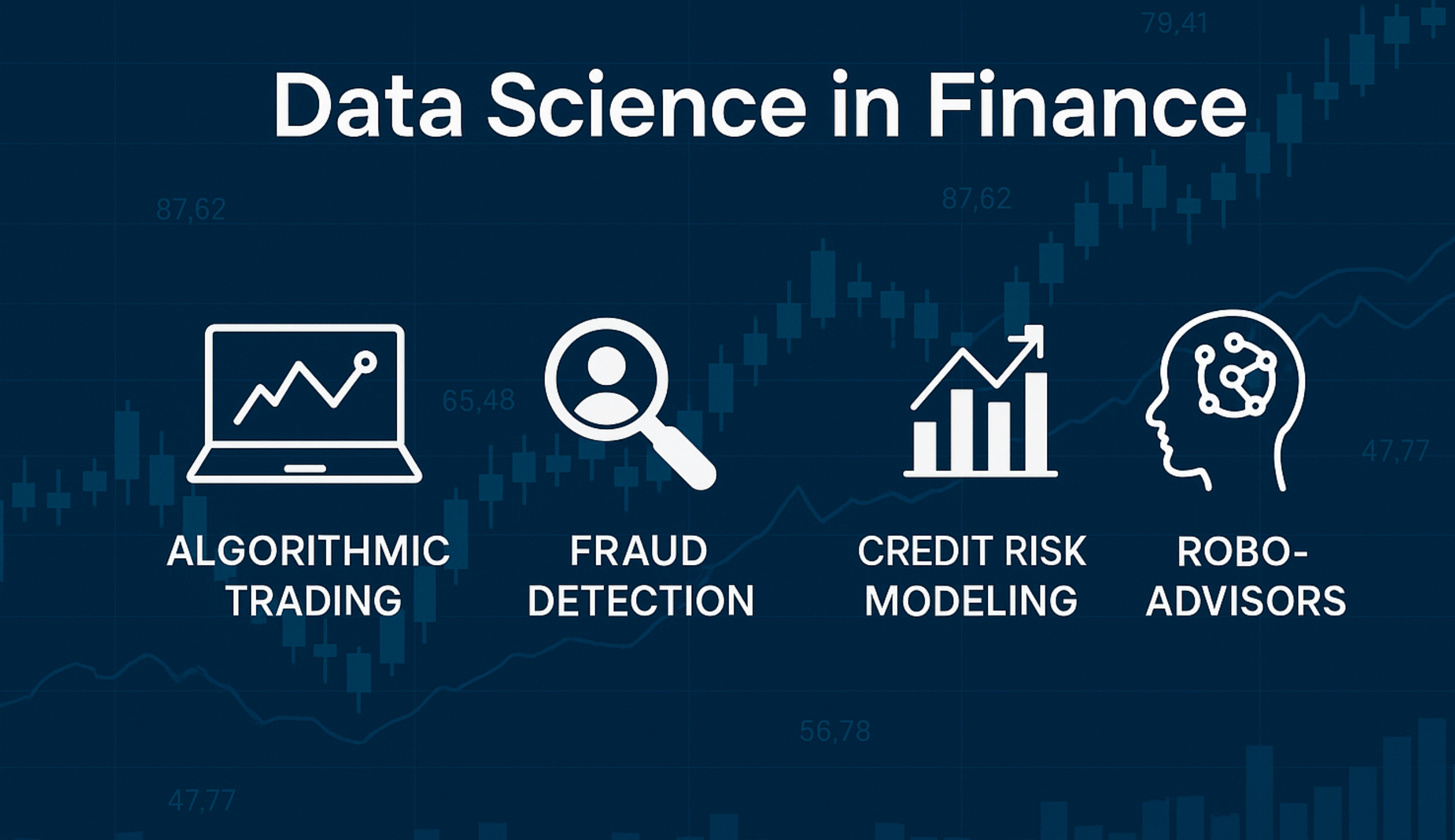
In today’s fast-paced financial world, data is the new oil, and data science is the engine that drives intelligent decisions. From Wall Street banks to fintech startups, data science is transforming how financial institutions analyze risk, forecast markets, detect fraud, and personalize services.
In this blog, we explore how data science is disrupting the finance industry, what technologies are leading the change, and how you can be a part of this financial revolution.
📌 What is Data Science in Finance?
Data science in finance refers to the use of techniques like machine learning, artificial intelligence (AI), and big data analytics to extract insights from vast volumes of financial data.
This involves:
- Predictive modeling
- Natural language processing
- Algorithmic trading
- Credit scoring
- Fraud detection
These methods go far beyond traditional Excel models and manual analysis, enabling real-time, intelligent decision-making.
🔍 Real-World Applications of Data Science in Finance
1. 📈 Algorithmic & Quantitative Trading
- Algorithms use historical data, patterns, and market signals to automate trades in milliseconds.
- Quantitative analysts (quants) use data science to build statistical trading strategies.
- Machine learning models like XGBoost, LSTM, or Reinforcement Learning predict stock movements.
💡 Example: A hedge fund may use a neural network trained on 10 years of market data to trade automatically during high volatility.
2. 🕵️♀️ Fraud Detection and Anti-Money Laundering (AML)
- Financial institutions use anomaly detection to identify fraudulent transactions in real-time.
- Data science enables risk profiling and tracking of suspicious behavior across accounts.
🔍 Tools Used: Isolation Forest, Logistic Regression, Autoencoders.
3. 📊 Credit Risk Modeling
Banks and fintech lenders rely on data science to:
- Assess a borrower’s likelihood of default.
- Customize interest rates.
- Speed up loan approvals using alternative credit data (e.g. mobile usage, social behavior).
4. 🧠 Robo-Advisors and Personal Finance Management
- Apps like Betterment, Wealthfront, or Robinhood use AI to recommend investments based on a user’s risk profile.
- Algorithms automatically rebalance portfolios and adjust for tax efficiency.
👥 This creates access to smart investing for even small retail users, not just millionaires.
5. 📰 NLP for Financial News & Sentiment Analysis
Natural Language Processing (NLP) helps in:
- Analyzing financial news, tweets, and earnings calls.
- Extracting market-moving sentiment to make faster decisions.
💡 Example: An NLP model detects negative tone in a CEO’s earnings call and adjusts a hedge fund’s short position instantly.
🧪 Code Example: Predicting Stock Returns using Machine Learning
pythonCopyEditimport pandas as pd
from sklearn.ensemble import RandomForestRegressor
from sklearn.model_selection import train_test_split

# Load sample financial data
df = pd.read_csv('financial_data.csv')  # Contains OHLCV + technical indicators
X = df.drop(['Return'], axis=1)
y = df['Return']

# Train model
X_train, X_test, y_train, y_test = train_test_split(X, y, test_size=0.2, random_state=42)
model = RandomForestRegressor()
model.fit(X_train, y_train)

# Predict and evaluate
predictions = model.predict(X_test)
print(f"Predicted returns: {predictions[:5]}")
📈 Top Tools and Technologies in Financial Data Science
| Tool/Library | Use Case |
|---|---|
| Python, R | Data manipulation and modeling |
| Pandas, NumPy | Data cleaning and transformation |
| Scikit-learn | ML algorithms |
| XGBoost, LightGBM | Fast gradient boosting |
| TensorFlow, PyTorch | Deep learning models |
| Plotly, Power BI | Interactive visualization |
| Snowflake, BigQuery | Big data processing |
🌍 The Future of Finance with Data Science
The finance industry is heading toward full automation. Some trends shaping the future:
- Explainable AI for transparent decision-making.
- Decentralized finance (DeFi) using AI to manage crypto and blockchain-based investments.
- ESG investing driven by real-time data analytics.
- Real-time risk management using streaming data (Kafka, Spark).
💼 Want a Career in Financial Data Science?
Recommended Roadmap:
- Learn Core Skills: Python, SQL, Statistics, Linear Algebra.
- Master Finance Concepts: Valuation, portfolio theory, time-series analysis.
- Work on Projects: Predict stock prices, detect fraud, build dashboards.
- Certifications:
- CFA + Python = unbeatable combo.
- Courses on Coursera, Udemy, edX (e.g. “AI in Finance”, “Machine Learning for Trading”).
🔚 Conclusion
Data science isn’t just a buzzword—it’s the backbone of the modern finance industry. From risk management to automated trading, the power of machine learning and AI is transforming how money moves and grows.
Whether you’re a finance student, data enthusiast, or aspiring quant, there’s never been a better time to dive into the intersection of finance and data science.