
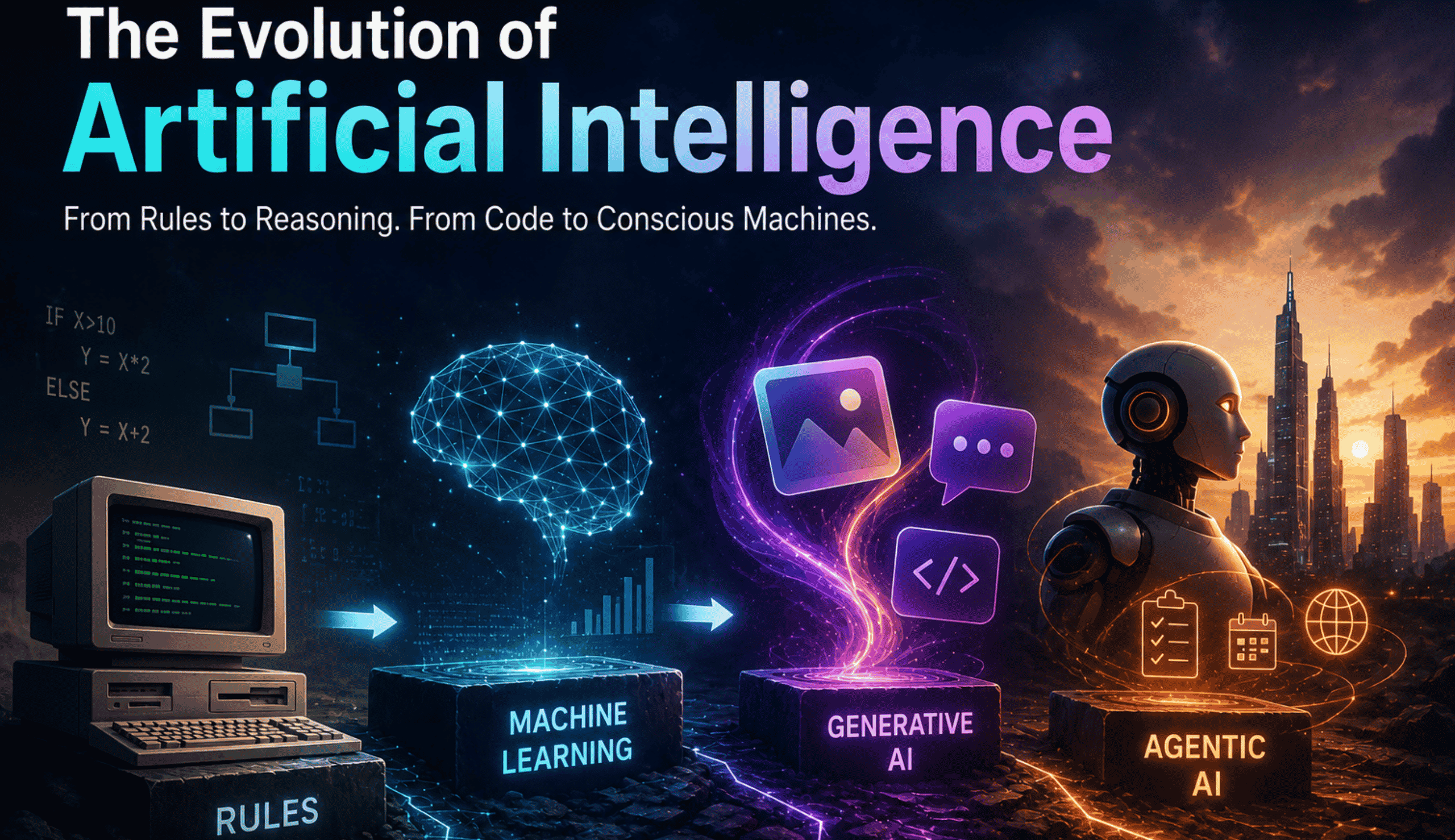
4 Powerful Stages of AI Evolution is rapidly transforming the modern world. From recommendation systems on Netflix and YouTube to AI chatbots, self-driving cars, healthcare systems, and intelligent business automation, AI is becoming one of the most important technologies of this generation.
But AI did not suddenly appear overnight.
The AI we see today is the result of decades of evolution in computing, mathematics, programming, and data science. It started with simple rule-based programming systems, evolved into Machine Learning capable of learning from data, advanced into Generative AI that can create human-like content, and is now entering the era of Agentic AI, where intelligent systems can reason, plan, and perform tasks autonomously.
Understanding the 4 Powerful Stages of AI Evolution is extremely important for students, developers, programmers, business owners, and future innovators because each stage builds directly upon the previous one.
This journey is not just about technology. It is about how humans are gradually teaching machines to think, learn, create, and act more intelligently.
Understanding the 4 Powerful Stages of AI Evolution
| Stage | Description |
|---|---|
| Traditional Programming | Humans manually define rules and instructions for computers. |
| Machine Learning | Machines learn patterns and make predictions using data. |
| Generative AI | AI creates original content such as text, images, code, audio, and videos. |
| Agentic AI | AI autonomously reasons, plans, makes decisions, and completes tasks. |
Traditional Programming: The Foundation of Modern Computing
Before Artificial Intelligence existed, computers relied completely on traditional programming.
In the early foundation of the 4 Powerful Stages of AI Evolution, traditional programming represents the stage where humans manually define every rule, condition, instruction, and logic that the computer follows. The machine itself has no understanding or intelligence. It simply executes commands exactly as written.
The basic logic looks like this:
Input + Rules = Output
If the rules are correct, the output will also be correct.
Traditional programming is deterministic, meaning the same input always produces the same output.
How Traditional Programming Works
Imagine building a simple calculator application.
A programmer manually writes instructions such as:
- If the user presses “+”, add two numbers
- If the user presses “−”, subtract numbers
- If the password is incorrect, show an error
- If the user enters invalid input, display a warning message
The computer cannot think beyond these instructions.
It cannot learn from experience.
It cannot adapt automatically.
Everything depends on human-written logic.
Real-World Uses of Traditional Programming
Traditional programming still powers many systems today, including:
- Banking systems
- Websites
- Mobile applications
- Operating systems
- Database management systems
- Calculator software
Popular programming languages include:
- Python
- Java
- C++
- JavaScript
- C#
Advantages of Traditional Programming
Traditional programming became the foundation of computing because it offers several important strengths.
Predictable Output
The same input always produces the same result.
Fast Performance
Traditional programs can execute simple tasks extremely quickly.
Human Control
Developers control every behavior of the software.
Reliability
Rule-based systems are highly reliable for structured tasks.
Limitations of Traditional Programming
Despite its strengths, traditional programming struggles with highly complex real-world problems.
No Learning Ability
Programs cannot improve automatically using experience or data.
Hard to Scale
Writing millions of rules manually becomes impossible.
Weak Pattern Recognition
Tasks like image recognition and language understanding are too complex for manually written logic.
Constant Manual Updates
Programmers must continuously modify systems when requirements change.
Why the World Needed Something More Powerful
As internet usage increased, massive amounts of data started being generated every second.
Companies needed systems capable of:
- Predicting customer behavior
- Detecting banking fraud
- Recommending products
- Understanding human language
- Recognizing faces and objects
Traditional programming could not handle these problems effectively.
This limitation led to the rise of Machine Learning.
Machine Learning: Teaching Computers to Learn from Data
Machine Learning revolutionized computing by allowing systems to learn patterns directly from data instead of relying entirely on manually written rules.
In the 4 Powerful Stages of AI Evolution, this stage marks a major shift from rule-based programming to data-driven learning.
The logic changed into:
Input + Data = Learned Patterns → Predictions
This was one of the biggest technological breakthroughs in history.
Instead of explicitly telling computers how to solve every problem, developers could now train models using examples.
The machine would automatically discover hidden relationships and improve performance over time.
Understanding Machine Learning with a Real-Life Example
Suppose you want to predict house prices.
Using traditional programming, you might manually create rules such as:
- Bigger houses cost more
- Houses near cities are expensive
- More bedrooms increase value
However, real-world pricing is far more complicated.
Machine Learning solves this problem differently.
You provide historical data including:
- House size
- Number of rooms
- Location
- Property age
- Previous selling prices
The model studies patterns within the data and learns relationships automatically.
After training, it can predict future house prices with impressive accuracy.
Types of Machine Learning
Machine Learning is generally divided into three major categories.
1. Supervised Learning
In supervised learning, the model learns using labeled data where correct answers are already known.
Real-Life Examples
- Email spam detection
- Predicting student exam scores
- Disease diagnosis
- Stock market prediction
Popular algorithms include:
- Linear Regression
- Logistic Regression
- Decision Trees
- Random Forest
- K-Nearest Neighbors (KNN)
2. Unsupervised Learning
In unsupervised learning, the system discovers hidden patterns without labeled outputs.
Real-Life Examples
- Customer segmentation
- Product recommendation systems
- User behavior analysis
- Market basket analysis
Popular algorithms include:
- K-Means Clustering
- PCA
- DBSCAN
3. Reinforcement Learning
Reinforcement Learning teaches AI through rewards and punishments.
The AI learns using trial and error.
Real-Life Examples
- Self-driving cars
- Robotics
- AI game systems
- Autonomous drones
The system continuously improves based on feedback from its environment.
Predictive Analysis: The Core Strength of Machine Learning
One of the most powerful applications of Machine Learning in the 4 Powerful Stages of AI Evolution is predictive analysis.
Predictive analysis uses historical data to predict future outcomes.
This transformed industries worldwide.
Real-World Applications of Predictive Analysis
Netflix and YouTube Recommendations
These platforms analyze viewing behavior to recommend content users may enjoy.
Banking Fraud Detection
Banks detect suspicious activities instantly using Machine Learning models.
Healthcare Systems
AI predicts diseases before symptoms become severe.
Stock Market Analysis
Traders use AI to analyze patterns and estimate future price movements.
Why Machine Learning Became Revolutionary
Machine Learning became powerful because it could:
- Learn automatically from data
- Handle enormous datasets
- Discover hidden patterns
- Improve continuously
- Make intelligent predictions
However, Machine Learning still had one important limitation.
It focused mainly on prediction and analysis.
It could predict outcomes, but it could not truly create new human-like content.
That limitation led to the next major breakthrough:
Generative AI.
Generative AI: AI That Can Create
Generative AI is one of the most important technological breakthroughs of the modern era.
In the broader journey of the 4 Powerful Stages of AI Evolution, Generative AI represents the stage where machines move from analyzing data to creating entirely new content.
Unlike traditional Machine Learning systems that mainly classify or predict data, Generative AI can create entirely new content.
This includes:
- Text
- Images
- Music
- Videos
- Code
- Voice
- Designs
Generative AI does not simply analyze information.
It generates original outputs.
How Generative AI Works
Generative AI learns patterns from extremely large datasets.
For example:
- Text models learn from books, articles, websites, and conversations
- Image models learn from millions of images and artworks
The AI studies structures, relationships, and patterns within the data.
Then it generates completely new outputs that resemble human-created work.
Real-Life Examples of Generative AI
ChatGPT
ChatGPT can generate articles, emails, conversations, explanations, and even programming code.
AI Image Generators
Tools like Midjourney and DALL·E create images from simple text prompts.
Example:
“Create a futuristic city with flying cars during sunset.”
The AI generates an entirely original image based on the description.
GitHub Copilot
AI assists developers by generating code automatically.
Large Language Models (LLMs)
Modern Generative AI is powered by Large Language Models, commonly called LLMs.
These models are trained on massive datasets containing:
- Books
- Websites
- Research papers
- Human conversations
- Articles
Popular examples include:
- GPT
- Gemini
- Claude
- Llama
These systems understand language structure, context, reasoning, and conversation flow.
Prompt Engineering: The Skill of Communicating with AI
As Generative AI became more advanced, people realized something extremely important:
The quality of AI output depends heavily on the quality of prompts.
This introduced Prompt Engineering.
Prompt Engineering is the process of designing clear and structured instructions to generate better AI responses.
The 5-Step Prompting Framework
A strong prompt usually includes five important parts.
1. Role
Tell the AI who it should act like.
Examples
- “Act like a professional Data Scientist.”
- “Act like an experienced teacher.”
2. Context
Provide background information.
Examples
- “I am a beginner learning Artificial Intelligence.”
- “The audience is non-technical students.”
3. Task
Clearly explain what you want the AI to do.
Examples
- “Explain Machine Learning with real-life examples.”
- “Write a blog about Generative AI.”
4. Constraints
Define limitations or conditions.
Examples
- “Use simple English.”
- “Keep the explanation under 1000 words.”
5. Format
Control the output structure.
Examples
- “Use headings and bullet points.”
- “Write in professional blog format.”
Example of a Good Prompt
Instead of writing:
“Explain AI.”
A better prompt would be:
“Act like an experienced AI teacher. I am a beginner learning Artificial Intelligence. Explain the evolution from traditional programming to Generative AI using real-life examples and simple language. Use clear headings and structured formatting.”
A structured prompt gives significantly better results.
Why Prompt Engineering Matters
Prompt engineering is becoming a valuable skill because it helps users:
- Communicate effectively with AI
- Generate accurate responses
- Improve productivity
- Save time
- Build AI-powered workflows
This skill is becoming important in:
- Data Science
- Programming
- Research
- Marketing
- Automation
- Content Creation
Agentic AI: The Next Evolution of Artificial Intelligence
The newest stage of the 4 Powerful Stages of AI Evolution is Agentic AI.
Agentic AI goes beyond generating content.
It can reason, plan, make decisions, use tools, and complete tasks autonomously.
This represents a major leap in AI capability.
What Makes Agentic AI Different?
Traditional Generative AI mainly responds to prompts.
Agentic AI can:
- Understand goals
- Break tasks into steps
- Use external tools
- Analyze situations
- Make decisions
- Adapt dynamically
- Execute workflows independently
Real-Life Example of Agentic AI
Suppose you tell an AI:
“Launch my business website.”
A normal Generative AI may only provide suggestions.
However, an Agentic AI could:
- Create a complete task roadmap
- Generate website content
- Analyze competitors
- Schedule marketing campaigns
- Track project progress
- Automate workflows
All with minimal human intervention.
AI Agents
AI agents are systems designed to perform tasks independently.
Examples include:
- AI customer support agents
- Autonomous trading bots
- AI coding assistants
- AI research systems
- Workflow automation tools
These systems combine:
- Large Language Models
- Memory systems
- Reasoning
- Planning
- Decision-making
- Tool usage
The Future of Artificial Intelligence
The future of AI will likely include:
- Fully autonomous AI assistants
- AI-powered businesses
- Personalized education systems
- Intelligent healthcare systems
- Advanced robotics
- AI-driven scientific research
AI will continue transforming nearly every industry.
However, human creativity, ethics, leadership, and critical thinking will remain essential.
AI is a powerful tool, but humans still provide direction, purpose, and values.
How the Entire AI Evolution Connects Together
Artificial Intelligence did not evolve in a single step. Each stage of AI development solved the limitations of the previous stage and created the foundation for the next generation of intelligent systems.
The journey of the 4 Powerful Stages of AI Evolution follows a connected progression where every technology builds directly upon earlier innovations
| AI Stage | Main Capability | Core Idea |
|---|---|---|
| Traditional Programming | Rule-Based Systems | Humans manually define instructions and logic. |
| Machine Learning | Learning from Data | Machines learn patterns and make predictions using historical data. |
| Generative AI | Content Creation | AI generates original text, images, code, audio, and videos. |
| Agentic AI | Autonomous Decision-Making | AI reasons, plans, uses tools, and performs tasks independently. |
Final Thoughts
Artificial Intelligence is evolving faster than most people realize.
Understanding the journey of the 4 Powerful Stages of AI Evolution from traditional programming to Agentic AI helps us understand both the present and future of technology.
For students, developers, programmers, data scientists, and future innovators, learning the 4 Powerful Stages of AI Evolution is becoming increasingly important.
The future belongs to people who can:
- Understand AI deeply
- Use AI effectively
- Communicate with AI properly
- Solve problems using AI tools
- Think critically about AI ethics and applications
AI is no longer just a technology trend.
It is becoming one of the foundational technologies shaping the future of modern civilization.
External Links
For deeper understanding of Artificial Intelligence, you can explore these trusted sources:
OpenAI Research → https://openai.com/research
Google AI → https://ai.google/
IBM Artificial Intelligence → https://www.ibm.com/artificial-intelligence